Showing posts with label Ornamental Fish. Show all posts

Sunday, August 23, 2015

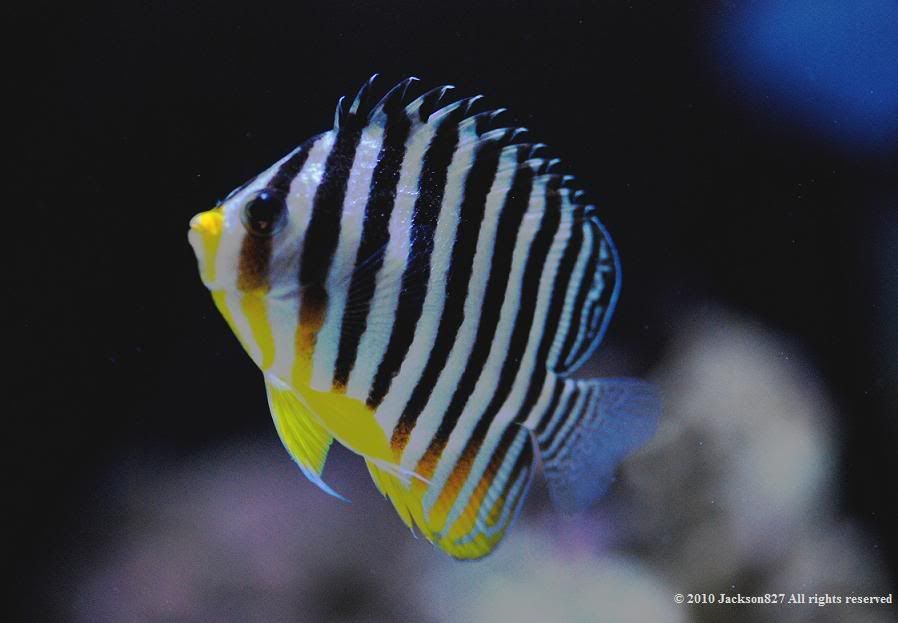
Saltwater Fish - Multibar Angelfish (Paracentropyge multifasciata)

Saltwater & Marine Fish - Multibar Angelfish (Paracentropyge multifasciata) 
The Multibar Angel, conjointly referred to as the numerous Banded Angelfish and Multibarred Angelfish, has individual black associated yellow vertical bands organized in an "every other" fashion, with a skinny stripe of white bordering every black band. The tail is white to yellow with tiny black speckles. A juvenile may be distinguished by a blue marking at the rear of the fin.

http://www.marineworld.com.pk/sites/default/files/Multibar%20Angelfish.jpg
The Multibar Angel needs a minimum tank size of seventy gallons with many concealment places and live rock for grazing. This angelfish is best unbroken because the solely species member during a tank.

The Multibar Angel, like different dwarf angels, ar hermaphroditic, troublesome to breed, and indistinguishable in color variations from male to feminine.

The Multibar Angel may be a particular eater; it prefers a spread of tiny meaty things, angelfish and fauna preparations, and live sponges. These consumption habits and therefore the attribute of changing into somewhat territorial upon acclimatisation, create this a difficult fish to stay.

Approximate Purchase Size: tiny 2" to 3" Medium 3" to 4" massive 4" to 5"
 KEY: freshwater fish, freshwater tropical fish, exotic freshwater fish, salt water fish tank, tropical fish, tropical fish store, flying fish, flying fish little rock, fly fishing, fish recipes, easy fish recipes, fish recipe, healthy fish recipes, grilled fish recipes, fish batter recipe, fish chowder recipe, white fish recipes, fishing games, bass fishing, bass fish, bass fishiing tips

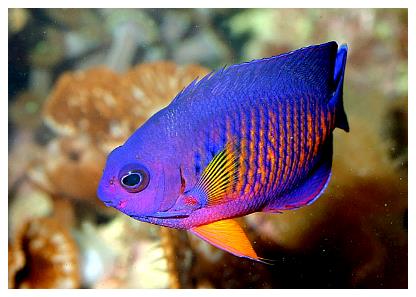
Saltwater Fish - Coral Beauty Angelfish (Centropyge bispinosa)


Saltwater Fish - Coral Beauty Angelfish (Centropyge bispinosa) 

Very common on the nice coral reef, the Coral Beauty Angelfish is additionally referred to as the Twospined or Dusky Angelfish. The body and head ar a deep purplish blue, highlighted with associate degree iridescent orange to yellow. The Coral Beauty Angelfish is one amongst the best angels to worry for.

It needs a seventy gallon or larger tank with numerous concealing places and live rock for grazing. Not a decent reef denizen, the Coral Beauty Angelfish is vulnerable to nip at stony and soft corals (sessile invertebrates).
Saltwater Fish - Coral Beauty Angelfish (Centropyge bispinosa)
The diet of the Coral Beauty Angelfish ought to carries with it Spirulina, marine alga, high-quality angelfish preparations, Mysis or frozen shrimp, and different quality meaty foods.

Approximate Purchase Size: Small: 1" to 1-3/4"; Medium: 1-3/4" to 2-1/2"; Large: 2-1/2" to four"


KEY: freshwater fish, freshwater tropical fish, exotic freshwater fish, salt water fish tank, tropical fish, tropical fish store, flying fish, flying fish little rock, fly fishing, fish recipes, easy fish recipes, fish recipe, healthy fish recipes, grilled fish recipes, fish batter recipe, fish chowder recipe, white fish recipes, fishing games, bass fishing, bass fish, bass fishiing tips

Saltwater Fish - Stars & Stripes Puffer (Arothron hispidus)

Saltwater Fish - Stars & Stripes Puffer (Arothron hispidus) 

 Saltwater Fish - Stars & Stripes Puffer (Arothron hispidus)

The Stars & Stripes Puffer is an ornate puffer that requires very little imagination to see how it received its common name. The upper half of the Stars & Stripes Puffer is covered with white spots that appear, from a distance, like stars upon the greenish tan body coloration. The lower half of the body has horizontal stripes that complete the stars and stripes ensemble. Typical of Arothron puffers, the base of the pectoral fins is darker in coloration. The Stars & Stripes Puffer is sure to make an endearing addition for puffer enthusiasts or anyone wanting personality in their larger, fish-only or fish-only-with-live-rock marine aquarium. 

Members of the genus Arothron, including the Stars & Stripes Puffer, are sometimes called "Fat Puffers" or "Dogface Puffers" and exemplify the typical puffer design. Though lacking pelvic fins and a hydrodynamic body shape, puffers are extremely maneuverable and are tenacious and capable predators. Like many "Fat Puffers," the Stars & Stripes Puffer displays an unusual degree of "intelligence" and "personality" and appears to quickly recognize their owners. 
 Saltwater Fish - Stars & Stripes Puffer (Arothron hispidus) 
In the wild, the Stars & Stripes Puffer inhabits a wide range of habitats including mangrove swamps, seagrass beds and reef flats. The ideal setup should be an established aquarium 180 gallon or larger with good filtration and a protein skimmer. Aquascape liberally with live rock and other materials to create an environment rich with nooks and crannies, caves, and overhangs while preserving easy access to large open areas. House with fish of similar size and temperament and be aware that the Stars & Stripes Puffer will eat invertebrates found in the aquarium using its fused beak-like teeth to crush open its prey.
The diet of the Stars & Stripes Puffer should include a variety of meaty food including squid, krill, clams, and hard shelled shrimp to help wear down their ever growing teeth.
Approximate Purchase Size: Small: 1-1/2" to 2-3/4"; Medium: 3-1/4" to 4-1/4"; Large: 5-1/4" to 6-1/4" 


key: freshwater fish, freshwater tropical fish, exotic freshwater fish, salt water fish tank, tropical fish, tropical fish store, flying fish, flying fish little rock, fly fishing, fish recipes, easy fish recipes, fish recipe, healthy fish recipes, grilled fish recipes, fish batter recipe, fish chowder recipe, white fish recipes, fishing games, bass fishing, bass fish, bass fishiing tips

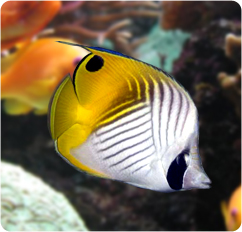
Saltwater Fish - Auriga Butterflyfish (Chaetodon auriga)


Saltwater Fish - Auriga Butterflyfish (Chaetodon auriga)

The Auriga Butterflyfish, also known as the Threadfin Butterflyfish, is one of the more popular and readily available butterflyfish. Generally a hardy species, in the wild it is found on inner and outer reef slopes. As with many fish, the Threadfin Butterfly's color and markings can vary with the region of origin. Red Sea specimens tend to lose the eyespot (false eye to confuse predators) on the dorsal fin.

The Auriga Butterflyfish is quite shy and should be provided multiple hiding places. It is safe to keep it in a live rock-only tank, although it will pick at the rock.
 https://www.bluezooaquatics.com/images/products/Fish/large/chaetodon_auriga.jpg

The Auriga Butterflyfish's diet should primarily consist of plankton frozen, freeze-dried, fresh or flake food is readily accepted. Also provide regular vegetable food source and vitamin-boosting supplements.
Approximate Purchase Size: Small: 1-1/2" to 2-1/4"; Medium: 2-1/2" to 3 1/2"; Large: 3 1/2" to 4 1/2" X Large 4 1/2" to 6" 

 QUICK STATS

Minimum Tank Size: 125 gallons

Care Level: Easy

Temperament: Peaceful

Reef Compatible: No

Water Conditions: 72-78° F, dKH 8-12, pH 8.2-8.4, sg 1.021-1.023

Max. Size: 8"

Color Form: Black, White, Yellow

Diet: Omnivore
Origin: Africa, Fiji, Hawaii, Indonesia, New Caledonia, Sri Lanka, Tonga
Family: Chaetodontidae


key: freshwater fish, freshwater tropical fish, exotic freshwater fish, salt water fish tank, tropical fish, tropical fish store, flying fish, flying fish little rock, fly fishing, fish recipes, easy fish recipes, fish recipe, healthy fish recipes, grilled fish recipes, fish batter recipe, fish chowder recipe, white fish recipes, fishing games, bass fishing, bass fish, bass fishiing tips

Saltwater Fish - Raccoon Butterflyfish (Chaetodon lunula)

http://lovesfish.blogspot.com/2015/08/saltwater-fish-raccoon-butterflyfish.html 

The Raccoon Butterflyfish is yellow-orange, but darker on the upper half of the body. It has a black patch around its eyes, with a broad white stripe posterior to it. Two black stripes bordered in yellow reach from the white stripe to the dorsal fin.
The Raccoon Butterflyfish is a peaceful fish that may reside in a 125 gallon or larger fish-only aquarium with other butterflyfish. It should not be kept in a reef tank since it will eat invertebrates and is deemed unsafe with corals. 

When first acquired, if it will not eat, it may be tempted with a small anemone. Once acclimated, it can be fed a varied diet of meaty foods, crustacean flesh, mysis shrimp, and frozen preparations several times daily.
Approximate Purchase Size: Small: 1-1/2" to 2-1/4"; Medium: 2-1/4" to 3 "; Medium/Large: 3" to 4"; Large: 4" to 5"; X large 5" to 6"


key: freshwater fish, freshwater tropical fish, exotic freshwater fish, salt water fish tank, tropical fish, tropical fish store, flying fish, flying fish little rock, fly fishing, fish recipes, easy fish recipes, fish recipe, healthy fish recipes, grilled fish recipes, fish batter recipe, fish chowder recipe, white fish recipes, fishing games, bass fishing, bass fish, bass fishiing tips

Freshwater Fish - Ryukin Goldfish, Assorted (Carassius auratus)

http://aquaanimania.com/wp-content/uploads/2012/06/ryukin-goldfish-carassius-auratus.jpg 

 Freshwater Fish - Ryukin Goldfish, Assorted (Carassius auratus)

The Ryukin Goldfish has a curved backbone, a fat belly and long feathery fins. It has a small, pointed mouth and the body is typically triangular in shape. There is a distinct hump on the back immediately behind the head. The Ryukin Goldfish comes in a variety of colors, including the Red/White, Calico, Red/Black and Red.

All goldfish are members of the carp group and are generally quite hardy. The Ryukin Goldfish will do well in a tank of 30 gallons of water or more with a fine gravel bottom and hardy, cold water plants, as well as backyard garden ponds of 180 gallons or more. Goldfish are diggers and will scatter the fine sand onto leaves, injuring thin and less hardy plants. Roots and well-rounded river rocks are a good addition to the aquarium. 

 http://aquaanimania.com/wp-content/uploads/2012/06/red-fantail-goldfish-carassius-auratus1-e1342031093259.jpg
 There appears to be a definite courtship ritual when Goldfish breed. Breeding often results in up to 1,000 eggs, with fry hatching in five to six days. The fry should be fed small pieces of live or prepared foods designed for egg-laying fish.

Goldfish are omnivorous and will eat all types of dried and live foods. Limit protein, however, to 30% of the diet. A Goldfish flake or pellet food will provide these fish with the proper nutrition.
Approximate Purchase Size: 1" to 1-1/2" 


key: freshwater fish, freshwater tropical fish, exotic freshwater fish, salt water fish tank, tropical fish, tropical fish store, flying fish, flying fish little rock, fly fishing, fish recipes, easy fish recipes, fish recipe, healthy fish recipes, grilled fish recipes, fish batter recipe, fish chowder recipe, white fish recipes, fishing games, bass fishing, bass fish, bass fishiing tips


Saturday, August 22, 2015

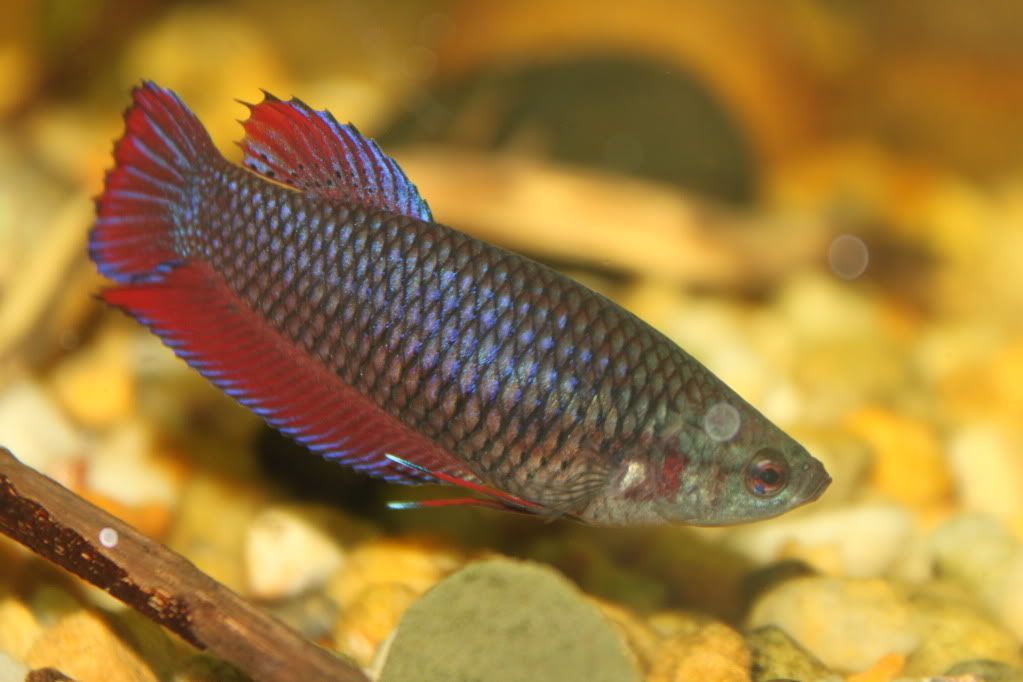
Freshwater Fish - Betta - Female (Betta splendens)

http://www.alessio.pointnet.eu/var/albums/betta-splendens-pesce-combattente/Betta_Splendens_HM_Copper_female_8151.jpg?m=1352232366 
Freshwater Fish - Betta - Female (Betta splendens) - The Betta is without a doubt, one of the most popular freshwater tropical fish. And it is easy to see why. The Betta is, first and foremost, brightly colored in shades of vibrant hues unparalleled among freshwater fish. Second, this member of the Belontiidae family is hardy when kept in ideal water parameters. Finally, despite their seemingly delicate beauty, Betta splendens requires simple care, which makes them a favorite of both beginning and advanced hobbyists.
Betta splendens is often referred to as Fighting Fish or "Siamese" Fighting Fish, since it has been bred over the years to be both colorful and combative, especially towards other males. As such, only one male Betta should be kept in an aquarium. However, smaller, shorter-finned - though often equally as colorful - females may be housed together with caution. The Betta should be housed with peaceful fish that will not nip at the Betta's glorious, flowing fins.
An ideal environment for the Betta is a well-filtered aquarium that holds a steady temperature of between 75° and 86°F. Though the Betta is often sold in small bowls in department stores, for best care, Betta splendens should be kept singly in aquariums of at least 1 gallon. It also prefers a variety of hiding places amongst the foliage of freshwater plants.
The Betta can be bred in the home aquarium. For breeding purposes, males and females can be temporarily housed together. Once laid by the female, the eggs are placed inside a bubblenest and tended by the male Betta. Fry appear in about 24 hours and must be fed very small food initially, such as crushed or powdered flakes and newly hatched brine shrimp. Fry will also take finely chopped hard-boiled egg yolk
Provide the Betta with a carnivore diet consisting of a quality flake food, frozen or freeze dried bloodworms and brine shrimp.
Approximate Purchase Size: 1" to 2"


key: freshwater fish, freshwater tropical fish, exotic freshwater fish, salt water fish tank, tropical fish, tropical fish store, flying fish, flying fish little rock, fly fishing, fish recipes, easy fish recipes, fish recipe, healthy fish recipes, grilled fish recipes, fish batter recipe, fish chowder recipe, white fish recipes, fishing games, bass fishing, bass fish, bass fishiing tips


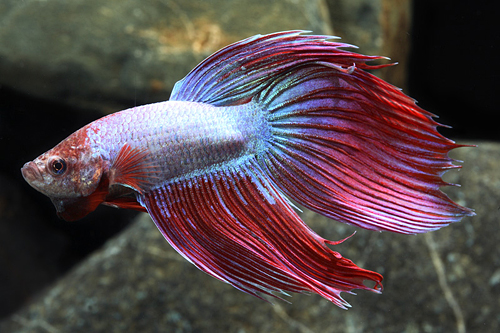
Freshwater Fish - Betta - Male (Betta splendens)

https://upload.wikimedia.org/wikipedia/commons/4/42/Betta_splendens_male_crowntail.png 
 Freshwater Fish - Betta - Male (Betta splendens) - The Betta is without a doubt, one of the most popular freshwater tropical fish. And it is easy to see why. The Betta is, first and foremost, brightly colored in shades of vibrant hues unparalleled among freshwater fish. Second, this member of the Belontiidae family is hardy when kept in ideal water parameters. Finally, despite their seemingly delicate beauty, Betta splendens requires simple care, which makes them a favorite of both beginning and advanced hobbyists.

Betta splendens is often referred to as Fighting Fish or "Siamese" Fighting Fish, since it has been bred over the years to be both colorful and combative, especially towards other males. As such, only one male Betta should be kept in an aquarium. However, smaller, shorter-finned - though often equally as colorful - females may be housed together with caution. The Betta should be housed with peaceful fish that will not nip at the Betta's glorious, flowing fins.
 http://www.seriouslyfish.com/wp-content/uploads/2012/03/Betta-splendens-delta.jpg
An ideal environment for the Betta is a well-filtered aquarium that holds a steady temperature of between 75° and 86°F. Though the Betta is often sold in small bowls in department stores, for best care, Betta splendens should be kept singly in aquariums of at least 1 gallon. It also prefers a variety of hiding places amongst the foliage of freshwater plants.

The Betta can be bred in the home aquarium. For breeding purposes, males and females can be temporarily housed together. Once laid by the female, the eggs are placed inside a bubblenest and tended by the male Betta. Fry appear in about 24 hours and must be fed very small food initially, such as crushed or powdered flakes and newly hatched brine shrimp. Fry will also 
take finely chopped hard-boiled egg yolk.
 http://www.segrestfarms.com/images/products/10000325.jpg
Provide the Betta with a carnivore diet consisting of a quality flake food, frozen or freeze dried bloodworms and brine shrimp. 

Approximate Purchase Size: 1-3/4" to 2-1/2" 


key: freshwater fish, freshwater tropical fish, exotic freshwater fish, salt water fish tank, tropical fish, tropical fish store, flying fish, flying fish little rock, fly fishing, fish recipes, easy fish recipes, fish recipe, healthy fish recipes, grilled fish recipes, fish batter recipe, fish chowder recipe, white fish recipes, fishing games, bass fishing, bass fish, bass fishiing tips

Freshwater Fish - Chinese Algae Eater (Gyrinocheilus aymonieri)

http://lovesfish.blogspot.com/2015/08/freshwater-fish-chinese-algae-eater.html 
Freshwater Fish - Chinese Algae Eater (Gyrinocheilus aymonieri) - The Chinese Algae Eater comes from Asia and has a slender body and is golden to brown in color. A darker stripe runs horizontally and is either solid or broken into spots. It is usually kept in aquariums for the purpose of keeping algae under control. 
http://lovesfish.blogspot.com/2015/08/freshwater-fish-chinese-algae-eater.html
A minimum of a 30-gallon aquarium is recommended with plenty of plants, rocks, and driftwood for hiding. It can handle different water conditions but water quality should remain constant to avoid stress. In smaller community tanks the Chinese Algae Eater will defend its territory. This species of algae eater can become aggressive when they become full grown. 

Breeding has not been seen or been successful in an aquarium setting. There is little known about sexing the male and female.  

The main source of food is algae on plants, rocks, glass, and driftwood. Algae based wafers should be provided if there is a lack of algae.

Approximate Purchase Size: Small: 1" to 1-1/2"; Medium: 1-1/2" to 2"; Large: 2" to 2-1/2"


key: freshwater fish, freshwater tropical fish, exotic freshwater fish, salt water fish tank, tropical fish, tropical fish store, flying fish, flying fish little rock, fly fishing, fish recipes, easy fish recipes, fish recipe, healthy fish recipes, grilled fish recipes, fish batter recipe, fish chowder recipe, white fish recipes, fishing games, bass fishing, bass fish, bass fishiing tips
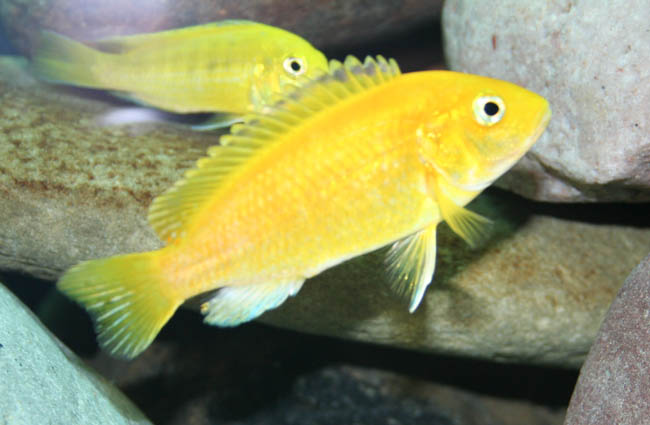
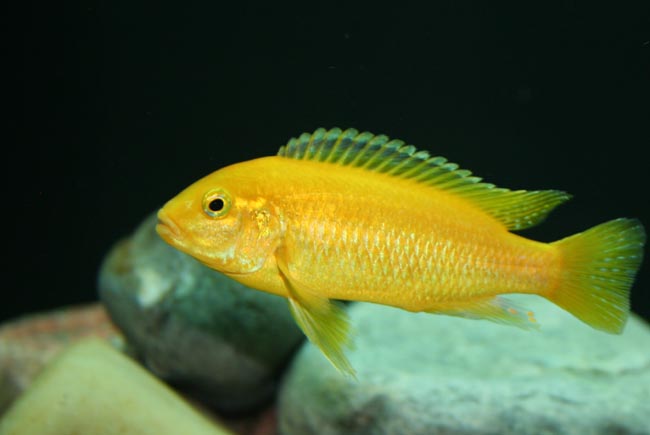
Freshwater Fish - Electric Yellow Cichlid (Labidochromis caeruleus)

http://www.feralbytes.net/aqua/wp-content/uploads/2011/06/femaleyellowlab.jpg
female
The Electric Yellow Cichlid is set apart from other African Cichlids by its striking electric yellow coloration. It injects an irresistible splash of bold color to the cichlid aquarium. Mature specimens flaunt contrasting horizontal black stripes and vertical bars to provide additional visual interest.

The Electric Yellow African Cichlid is also known as the Yellow Lab or Electric Yellow Lab. Considered a newer species and referred to commercially as Labidochromis tanganicae, this cichlid lives in the waters of Lake Malawi between the islands of Charo and Mbowe. First displayed at Burundi in the early 1980's and exported from there, the Electric Yellow was mistakenly believed to come from Lake Tanganyika. 
http://www.feralbytes.net/aqua/wp-content/uploads/2011/06/maleyellowlab.jpg
male
  A peaceful and shy cichlid compared to other African Cichlids, the Electric Yellow still displays distinct social and territorial behaviors. The Electric Yellow will act aggressively towards fish of similar body shape and color perceived to be a threat for food and mate. The aquarium should include a sandy bottom, robust plants, caves, and rocks.

The female lays her eggs on the surface of rocks and then scoops them into her mouth where they brood for 18 days before being released.
The Electric Yellow Lab needs both meaty foods and greens such as brine shrimp, bloodworms, and quality flake or pellet food containing vegetable matter. 

Approximate Purchase Size: Small: 1 1/2" to 2"; Medium: 2" to 3"; Large: 3" to 5" 


key: freshwater fish, freshwater tropical fish, exotic freshwater fish, salt water fish tank, tropical fish, tropical fish store, flying fish, flying fish little rock, fly fishing, fish recipes, easy fish recipes, fish recipe, healthy fish recipes, grilled fish recipes, fish batter recipe, fish chowder recipe, white fish recipes, fishing games, bass fishing, bass fish, bass fishiing tips


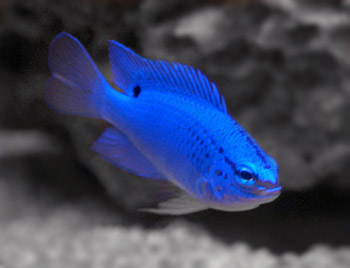
Blue Damselfish (Chrysiptera cyanea) - Saltwater Fish

The Blue Damselfish is probably the best selling marine fish in the United States. Beginning hobbyists relish its hardiness and small size, while advanced aquarists praise the color and activity this member of the Pomacentridae family brings to the aquarium. Female Blue Damselfish are completely blue. Males, on the other hand, have an orange tail and are commonly called the Orangetail Blue Damselfish or Blue Devil Damselfish.
Native to reefs across the Indo-Pacific, Chrysiptera cyanea is usually busy defending a small territory. Interestingly, the Blue Damselfish has the ability to hide in a hole or crevice and darken to an almost black color. This usually happens when it is threatened. After the perceived threat is gone, the Blue Damselfish will return to its electric blue color in a matter of seconds.
The Blue Damselfish is somewhat aggressive, so its housing should be large enough to easily accommodate multiple specimens. It is a good fish for beginners and makes an ideal companion fish for saltwater aquariums of over 30 gallons. The Blue Damselfish is also a great choice for reef aquariums with invertebrates. As the Blue Damselfish matures, it may demonstrate pronounced territorial behavior towards future additions to the aquarium. If keeping the Blue Damselfish with other damselfish, provide multiple hiding places to break up territories and decrease aggression
The diet of the Blue Damselfish should consist of flaked and frozen foods, and herbivore preparations.
Approximate Purchase Size: 1" to 2"


key: freshwater fish, freshwater tropical fish, exotic freshwater fish, salt water fish tank, tropical fish, tropical fish store, flying fish, flying fish little rock, fly fishing, fish recipes, easy fish recipes, fish recipe, healthy fish recipes, grilled fish recipes, fish batter recipe, fish chowder recipe, white fish recipes, fishing games, bass fishing, bass fish, bass fishiing tips